Weights and Dimensions
Which standard governs which number, and where to find the live tables.
Reducing flange dimensions are mostly the larger size flange dimensions. That single sentence answers most of the questions, and the exceptions are the interesting part.
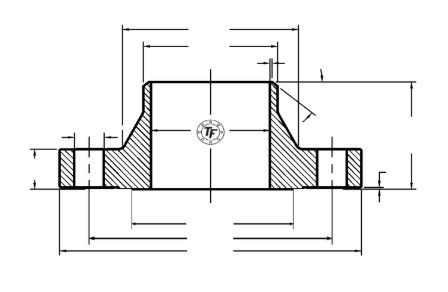
Under ASME B16.5 a reducing flange takes the dimensions of the larger nominal pipe size, the outside diameter, the thickness, the bolt circle, and the number and size of the bolt holes. What changes to suit the smaller size is the bore, and on a weld neck the hub diameter and the length through hub.
The consequence worth noting is the thickness. A reducing flange is not thinned down to suit the smaller bore. It keeps the larger size thickness, because the bolt loads and the moment arm belong to the larger bolt circle. That makes a reducing flange heavier than the small-size flange it replaces, and that weight is sometimes the reason a designer chooses a reducer and a standard flange instead.
There is a practical limit on how far a reducing flange should drop, and it is a matter of good practice more than a single published number. Drop too far and there is not enough material left to support the hub on a weld neck, and the flow transition becomes severe. Two nominal sizes is the figure most shops work to. Past that, expect to be asked to justify it, and expect the answer to be a reducer.
The standards that matter
| Standard | Scope |
|---|---|
ASME B16.5 | Steel pipe flanges and flanged fittings, NPS 1/2 through 24 |
ASME B16.47 | Large diameter steel flanges, NPS 26 through 60, Series A and Series B |
ASME B16.20 | Metallic gaskets for pipe flanges, including ring joint, spiral wound and jacketed |
ASME B16.24 | Cast copper alloy pipe flanges and flanged fittings |
ASME B16.1 | Gray iron pipe flanges and flanged fittings |
AWWA C207 | Steel pipe flanges for waterworks service, Class B, D, E and F |
MSS SP-44 | Steel pipeline flanges, the origin of B16.47 Series A |
API 6A | Wellhead and christmas tree equipment, including 6B and 6BX ring groove flanges |
ASME B31.3 | Process piping. The design code that turns material allowables into a rating |
Pressure classes we supply
75, 125, 150, 175, 250, 300, 350, 400, 600, 900, 1500 and 2500, plus API 5K, 10K, 15K and 20K. High yield and low temperature grades are available across the range.
On weights
Published flange weights are nominal. They are calculated from the standard geometry at a nominal density and they do not account for machining allowance, the actual bore, the facing, or the specific gravity of the alloy you are ordering. For rigging, shipping and structural support, ask us for the calculated weight of the actual part rather than working from a table.
This matters more than it sounds at the large end. A flange that a table calls 900 pounds can land meaningfully off that once the real bore and facing are accounted for, and rigging plans do not like surprises.
This page is orientation, not a dimension table. Live dimensional tables for the ASME B16.5 and B16.47 patterns that reducing flanges are built on are maintained on the Texas Flange site. The governing document is always the current edition of the applicable standard. Confirm any dimension against the standard, or with us, before fabrication.
Texas Flange dimensional tables · Request a dimensioned drawing
Need the real weight or a verified dimension?
Send the print, or send the size, class and grade. Texas Flange quotes quickly.
Request a QuoteOr call 281-484-8325 and ask for the reducing flanges desk.