Reducing Slip-On Flanges
The bore sized for the smaller pipe, everything else from the larger. The most common reducing pattern and the easiest to get right.
A reducing slip-on flange is a full-size slip-on flange with a bore machined for a smaller pipe. The pipe slides into the bore and is fillet welded front and back, exactly as on a standard slip-on. Everything else about the flange belongs to the larger size.
It is the reducing pattern you should reach for first, because it has no hub and therefore none of the geometric constraints that make reducing weld necks awkward.
The geometry
| From the larger size | From the smaller size |
|---|---|
| Flange outside diameter | Bore, sized to accept the smaller pipe OD |
| Flange thickness | Nothing else |
| Bolt circle, hole count and hole size | |
| Hub outside diameter and height | |
| Facing and facing finish |
Only the bore changes. That is what makes this pattern simple. A slip-on already has a substantial ring of material around its bore, and boring it smaller leaves more material behind, not less.
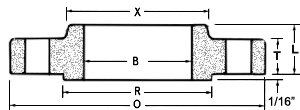
Welding it
Standard slip-on practice, and it applies unchanged to the reducing version. Two fillet welds:
- The outside weld, at the hub, where the pipe emerges from the back of the flange. This is the structural weld and it carries the load.
- The inside weld, at the bore on the face side. This seals the annular gap between the pipe OD and the flange bore.
Both are required. The internal weld is sometimes treated as optional by people trying to save time, and it is not. Without it, the gap between pipe and flange bore is a dead crevice open to the process, which in any corrosive or fouling service is where failure starts. It also leaves an unsupported pipe end inside the joint.
Pipe insertion depth. On a standard slip-on the pipe is set back from the flange face so the internal weld has room and the gasket seats on flange metal, not on pipe end. The reducing version is no different, and the setback should be on the drawing rather than left to the fitter.
How far it can drop
Further than a weld neck, because there is no hub to run out of. The practical limits are:
- Fillet weld geometry. The internal weld sits in the bore. On an aggressive reduction the bore becomes a deep narrow hole and access for that weld gets difficult.
- Flow step severity. The bigger the drop, the more abrupt the expansion into the larger line, with all the turbulence and pressure loss that follows.
- Load path. At some point you have a very large flange supported by a very small pipe, and the bending capability of that arrangement needs checking rather than assuming.
Two to three nominal sizes is the sensible working range. Past that, a reducer with a standard flange is the cleaner engineering answer.
Slip-on versus weld neck, in reducing form
| Factor | Reducing slip-on | Reducing weld neck |
|---|---|---|
| Geometric constraint | Mild, no hub to match | Significant, hub must suit the smaller pipe |
| Practical size drop | Two to three sizes | Two sizes |
| Welding | Two fillet welds, easier fit-up | One full penetration butt weld |
| Schedule dependency | Bore follows pipe OD only | Bore must match pipe ID, so schedule is essential |
| Fatigue capability | Lower | Higher |
| Radiography | Fillet welds, not normally radiographed | Butt weld, radiographable, access permitting |
| Cost | Lower | Higher |
| Crevice risk | Present if the internal weld is skipped | None, full penetration joint |
Where reducing slip-ons go
Mostly into moderate duty service where the abrupt transition does not matter and the saving does:
- Utility water, air and steam headers with branch takeoffs
- Tank and vessel connections where the nozzle is larger than the line
- Pump and equipment discharge tie-ins, discharge side rather than suction
- Retrofit work landing a smaller line on existing drilling
- Waterworks and low pressure process piping
Keep them out of high velocity service, slurry, pump suction and anywhere near a flow meter. See reducing flange vs pipe reducer.
Related reducing patterns
Reducing threaded flanges are tapped for the smaller pipe to ASME B1.20.1, and they suit small bore utility work and retrofits where welding is not permitted. Reducing socket weld flanges have a socket bored for the smaller pipe with a fillet weld at the hub, for small bore work where a threaded joint is unacceptable. Reducing lap joint puts a loose backing ring on the larger pattern behind a smaller stub end.
More in reducing threaded and socket weld flanges.
Common questions
Why is reducing slip-on the most common reducing pattern?
Because there is no hub to constrain it. A slip-on is a thick ring with a bore, and boring it smaller leaves more material rather than less. The geometry stays sensible across a bigger size drop than a weld neck tolerates, and it is cheaper to make.
Does a reducing slip-on get welded inside and out?
Standard slip-on practice is two fillet welds, one at the hub on the outside and one at the bore on the inside face. That applies to the reducing version as well. The internal weld is what protects the gap between the pipe OD and the flange bore from becoming a crevice, so skipping it is not a saving.
How far can a reducing slip-on drop?
Further than a weld neck, but two to three nominal sizes is still the sensible working range. The limits are the material left around the bore, the fillet weld geometry at the reduced bore, and how severe a flow step you are willing to accept. Past that a reducer with a standard flange is cleaner.
Is a reducing slip-on suitable for high pressure?
It is available across the class range, but slip-on flanges in general have lower fatigue capability than weld necks and some specifications restrict them above certain classes or in certain services. Check the project specification. Where the class is high and the duty is cyclic, use a weld neck.
Can I bore out a standard slip-on to make a reducing one?
Boring a larger slip-on down to a smaller pipe size is exactly how many of these are made, and it is legitimate when done from the correct starting forging with the finished dimensions verified. What is not acceptable is a field modification with no drawing, no dimensional check and no record. If the part matters, buy it machined and certified.
Reducing slip-on flanges
Give us the flange size, the bore size, the class and the facing. We will confirm the reduction is sensible and quote it.
Send the print, or send the size, class and grade. Texas Flange quotes quickly.
Request a QuoteOr call 281-484-8325 and ask for the reducing flanges desk.