Reducing Weld Neck Flanges
The larger flange ring with the smaller hub and bore. The most demanding reducing pattern, and the one with the real limits.
A reducing weld neck flange is a full-size flange ring on a small-size hub. It bolts to a larger flange and butt welds to a smaller pipe. Of all the reducing patterns, this is the one where the geometry actually constrains what is possible.
The geometry
Per ASME B16.5, the dimensions divide cleanly between the two sizes:
| From the larger size | From the smaller size |
|---|---|
| Flange outside diameter | Bore |
| Flange thickness | Hub diameter at the weld end |
| Bolt circle diameter | Length through hub |
| Number and size of bolt holes | Weld end preparation |
| Facing and facing finish |
Note that the thickness stays large. A reducing weld neck is not a lightened part. It is a large flange that happens to end in a small pipe connection, and it weighs accordingly.
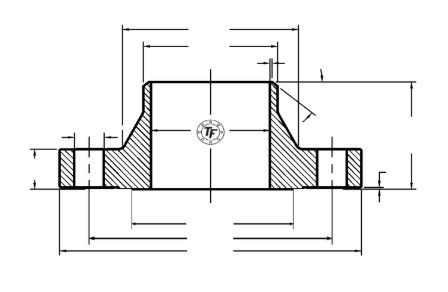
Why the reduction is limited
Picture the section. On a standard weld neck, the hub tapers gently from the flange ring down to the pipe OD, and that taper is what carries load smoothly from the bolts into the pipe wall. It is one of the reasons a weld neck outperforms a slip-on in fatigue.
Now hold the ring at a larger size and shrink the hub. The taper gets steeper and shorter. Drop far enough and it stops being a taper and becomes a step, with a sharp change of section right where load is being transferred.
Three consequences follow:
- Stress concentration at the transition, which matters under cyclic or fatigue loading.
- Less material to machine from, which at some point makes the part impractical to produce from a standard forging.
- A severe flow discontinuity, because the bore steps up abruptly into the larger line.
Two nominal sizes is the working limit. That is shop practice and engineering judgement rather than a single number in a table, and it is the figure most fabricators and specifying engineers hold to. Past two sizes, expect to justify it, and expect the recommendation to be a concentric reducer with a standard weld neck flange.
The schedule question
This is the single most common reason a reducing weld neck arrives wrong.
The hub bore has to match the inside diameter of the actual pipe it is welding to. Nominal size alone does not determine that. A 6 inch Schedule 40 pipe and a 6 inch Schedule 80 pipe have the same outside diameter and very different bores.
Get it wrong and the root of the butt weld has a step in it. That is a stress concentration, a turbulence source, a crevice, and on a radiographed weld it is a rejectable condition. It cannot be corrected after the fact without re-machining.
So the line item needs the schedule or the wall thickness of the smaller pipe, every time.
Welding and inspection
- The weld is a standard butt weld at the small end. Nothing unusual about the joint itself.
- Bore match matters more than usual, for the reasons above.
- Check radiography access early. The large flange ring sits close behind the weld and can interfere with film placement or ultrasonic probe access. This is a design stage conversation, not a fabrication stage surprise.
- Heat sink effect. The heavy ring pulls heat out of the joint faster than a standard weld neck would. On alloy steels that affects preheat and cooling rate, so the welding procedure should account for the actual part, not a generic one.
- Post weld heat treatment, where required, has to consider the section thickness difference across the part.
Where it genuinely belongs
Reducing weld necks earn their place in specific situations:
Equipment nozzle mismatch
A vessel, pump or valve with a larger flange than the line serving it, where the equipment flange is fixed and cannot be changed.
Tight axial space
Where a reducer plus a standard flange simply does not fit between the equipment and the first support or bend.
Deleting a weld on critical service
One fewer joint to make, inspect, radiograph and document. On high integrity service that is a real saving and a real risk reduction.
Retrofit into existing drilling
An existing flange stays in place and a smaller line has to land on it. Nobody is redrilling the mating flange.
When to walk away from it
Choose a reducer and a standard weld neck when any of these apply:
- The drop is more than two nominal sizes
- The service is cyclic, vibrating or fatigue driven
- Velocity is high, or the fluid carries solids
- It is pump suction and NPSH margin is tight
- Pressure drop is being counted across the system
- A flow meter sits anywhere near downstream
Full comparison at reducing flange vs pipe reducer, and see reducing weld neck bore, hub and welding.
Materials and sizes
We machine reducing weld necks in carbon steel A105, A350 LF2 and LF3, A694 and SA-516-70, in chrome alloys F1 through F91, in stainless F304 and F316 with their dual, H and L variants, in duplex F51 and F53, and in nickel alloys including Hastelloy, Inconel, Incoloy and Monel. Classes 150 through 2500, plus API 5K through 20K, in sizes through 203 inches.
Past the published tables the part is a drawing. Send the print. See CAD and 3D drawings.
Common questions
What makes a reducing weld neck harder than a reducing slip-on?
The hub. A slip-on just needs a bore through a thick ring, and the ring has plenty of material. A weld neck has a tapered hub that has to match the smaller pipe OD for a butt weld, while the ring stays the larger size. That means a large, abrupt change of section inside one forging, and the further you drop, the less material is left in the transition.
How far can a reducing weld neck drop?
Two nominal sizes is the practical working limit in most shops. The constraint is material in the transition between a large ring and a small hub, and it tightens as the ring gets relatively larger. It is engineering judgement rather than a single published number, so a bigger drop needs justifying and usually ends up as a reducer with a standard weld neck.
Do I need to state the pipe schedule?
Yes, always, and it is the item most often left off. The hub bore has to match the inside diameter of the specific pipe being welded to it. Same nominal size, different schedule, different bore. Without the schedule we cannot machine the hub, and a mismatched bore means a bad weld root.
Can a reducing weld neck be radiographed like a normal butt weld?
The weld itself is a standard butt weld at the small end and it inspects normally. What needs thought is access, because the large flange ring sits close behind the weld and can obstruct film placement or probe access. Raise it with the inspection group at design stage rather than at fabrication.
Is a reducing weld neck as strong as a standard one?
In the flange ring, yes, because the ring is a full larger-size flange. The question is the transition region, where the section changes abruptly. For static pressure duty it is fine within the normal reduction limits. For high cyclic or fatigue service, the discontinuity is a stress concentration and a reducer with a standard weld neck is the more conservative arrangement.
Reducing weld neck flanges
Send both sizes, the class, and the schedule of the smaller pipe. If the reduction is too aggressive to be sound, we will tell you before you buy it.
Send the print, or send the size, class and grade. Texas Flange quotes quickly.
Request a QuoteOr call 281-484-8325 and ask for the reducing flanges desk.